I’ve knocked on 25,000 doors and personally closed more than a thousand leads, and I can tell you the price is rarely the real problem. The problem is how the price was built and how it was presented.
Most contractors price one of two ways: they copy what the competition charges, or they guess. Both leave money on the table. This post shows you how to build a price that pays you, the markup mistake that quietly costs thousands, and how to present it so more homeowners say yes without you dropping your number.
Step 1: Know your real costs
Before you can price a job, you need to know what it actually costs you. Include:
- Materials, including waste, delivery and disposal.
- Labor, at your real cost per hour: wages plus payroll taxes, workers’ comp, benefits and drive time.
- Equipment and rentals.
- Permits and fees.
- Overhead: your share of the truck, insurance, phone, software, office, marketing and your own salary.
Overhead is the one most contractors skip. If it isn’t in your price, it’s coming out of your profit.
Step 2: Markup vs. margin (the expensive mistake)
Markup is what you add to your cost. Margin is the share of the final price that’s profit. They aren’t the same number.
| Your cost | Markup | Price | Margin (profit ÷ price) |
|---|---|---|---|
| $1,000 | 20% | $1,200 | 16.7% |
| $1,000 | 30% | $1,300 | 23.1% |
| $1,000 | 50% | $1,500 | 33.3% |
| $1,000 | 100% | $2,000 | 50.0% |
If you need a 30% margin and you add 30% to your cost, you’ll come in short on every job. To hit a target margin, use this instead:
Price = Cost ÷ (1 − target margin)
Example: A job costs you $4,000 and you want a 30% margin. $4,000 ÷ 0.70 = $5,714, not $5,200.
Step 3: Stop pricing off the competition
If you’re the cheapest, you’re competing with every bad contractor in town. Someone will always be willing to go lower, usually by cutting corners or skipping insurance.
Price from your costs and the margin your business needs. Then win on value: how fast you respond, how you communicate, your reviews, your warranty and the way you present the job.
Step 4: Give three options
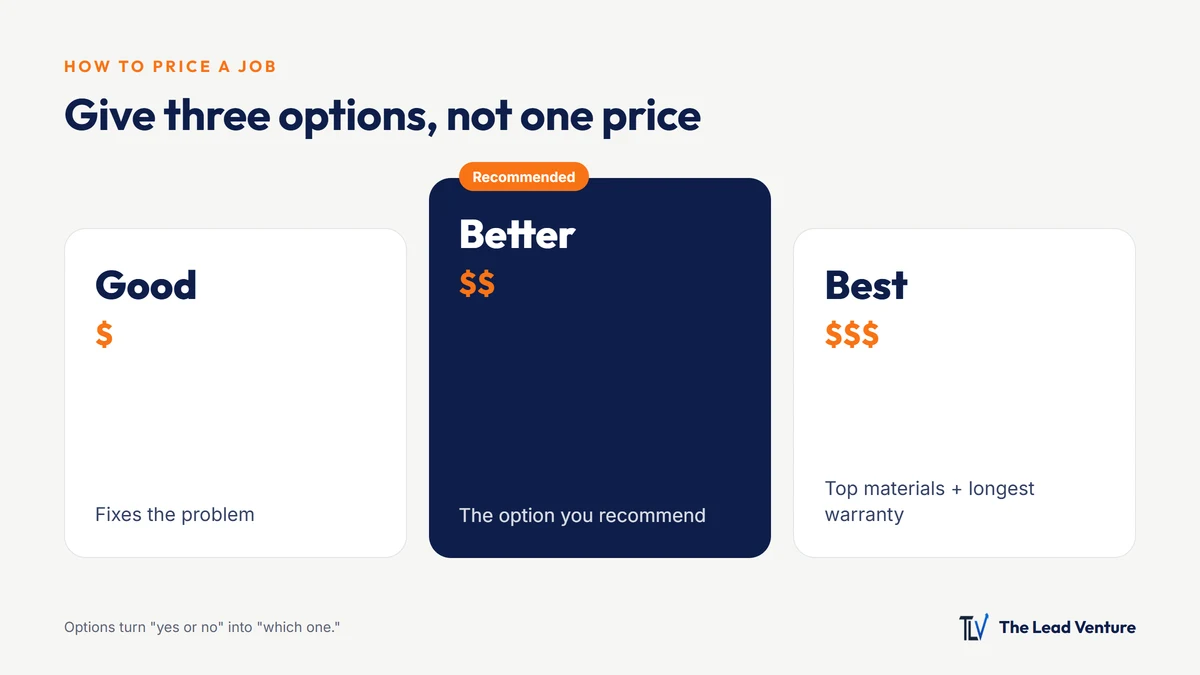
Options turn “yes or no” into “which one.” Instead of one take-it-or-leave-it number, offer:
- Good: fixes the problem with standard materials.
- Better: upgraded materials or extras. This is the option you recommend.
- Best: top materials, extra features and your longest warranty.
Homeowners like having a choice. It keeps the conversation on what they want instead of whether to hire you, and some will choose the higher options on their own.
Step 5: Present the price with confidence
- Get both decision-makers at the table. It prevents “I need to talk to my spouse.”
- Show the value before the price. Walk through the problem, your solution, your warranty and photos of similar jobs.
- Say the number clearly, then stop talking. Don’t apologize for it or explain it away.
- Offer financing if you have it. A monthly payment is easier to say yes to for big jobs.
- Ask about hesitation before you discount. “What’s making you hesitate?” often reveals a timing or scope question, not a price problem.
If they still need time, follow up with our after-estimate follow-up schedule.
Your pricing checklist
- Calculate your true labor cost per hour
- Add up your monthly overhead and include a share in every job
- Set a target margin and price with Cost ÷ (1 − margin)
- Build good, better and best options for your most common jobs
- Practice presenting the price, then stop talking
- Ask what’s behind any hesitation before offering a discount
- Review your margins on finished jobs every month
The bottom line
Pricing isn’t about being cheap or expensive. It’s about knowing your numbers, charging what the work is worth, and giving homeowners a confident, clear choice. When more leads come in and get answered fast, you can afford to walk away from jobs that don’t pay. That’s what the Booked Solid System is built to do.