Most contractors treat the estimate like a receipt: a few line items, a total, and a signature line. Then they wonder why homeowners “need to think about it.”
An estimate is a sales document, not a price tag. It’s often the only thing the homeowner looks at after you leave, the thing they show their spouse, and the thing they compare against two other bids. This post walks through what a closing estimate includes, how to deliver it, and the one federal rule every in-home seller should know.
What every estimate should include
The basics
- Your business name, logo, phone, email and license number (if your trade requires one).
- The homeowner’s name, address and the date.
- Estimate or quote? Say which it is, and what could change the price.
A scope of work they can understand
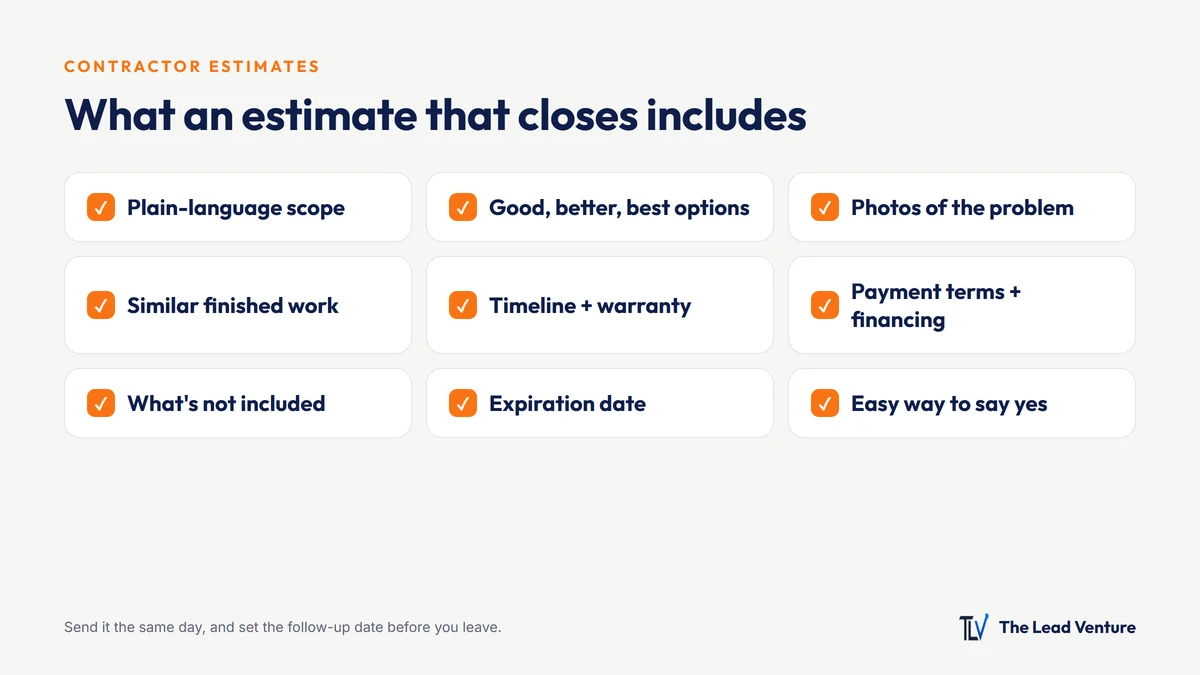
Write the scope in plain language, not supply-house shorthand. “Remove existing shingles down to the deck, replace damaged decking as needed, install synthetic underlayment and architectural shingles” tells the homeowner what they’re paying for. “R&R roof” doesn’t.
Options, not one number
Give good, better and best options so the decision becomes “which one” instead of “yes or no.” Our guide on how to price a job covers how to build them.
Proof
- Photos of the problem you found at their home.
- Photos of a similar job you finished nearby.
- A couple of short reviews from local customers.
The details that prevent arguments later
- Timeline: when you can start and how long it takes.
- Warranty: what’s covered and for how long.
- Payment terms: deposit, progress payments and final payment.
- Financing options, if you offer them.
- What’s not included: permits, haul-away, landscaping repair, or anything else that’s extra.
- Expiration date: for example, 30 days. It protects you from material price changes and gives the homeowner a reason to decide.
An easy way to say yes
A signature line, an online “approve” button, or a link to pay the deposit. If it’s hard to accept, people put it off.
How to deliver it
The estimate that arrives tonight beats the one that arrives next week.
- Send it the same day, ideally before you leave the driveway.
- Walk them through it in person or on a call. Don’t just email a PDF and hope.
- Make sure both decision-makers see it.
- Agree on a follow-up date before you leave: “Let’s talk Thursday.”
- Follow up with our after-estimate follow-up schedule.
The FTC Cooling-Off Rule for in-home sales
If you sell at the homeowner’s kitchen table, know this rule. The FTC’s Cooling-Off Rule generally gives buyers until midnight of the third business day to cancel certain sales made at their home (and some other locations), and the seller must give the buyer:
- A copy of the contract or receipt, dated, with your name and address, explaining the right to cancel.
- Two copies of a cancellation form.
The FTC lists exceptions, including some sales needed to meet an emergency and repairs or maintenance the homeowner asked you to come out for (though extra items you sell beyond the requested repair can still be covered). Many states have their own home solicitation rules too. Have an attorney review your estimate and contract templates.
Your estimate checklist
- Business details, license number and date
- Clearly marked as an estimate or a quote
- Plain-language scope of work
- Good, better and best options
- Photos of the problem and similar finished work
- Timeline, warranty and payment terms
- What’s not included
- Expiration date
- Easy way to accept
- Cooling-off notice and cancellation forms for in-home sales
- Sent the same day, with a follow-up date set
The bottom line
A clear, complete estimate delivered fast does a lot of the selling for you. Show the problem, offer options, prove you’ve done it before, spell out the details, and make it easy to say yes. The Booked Solid System handles the follow-up after you send it, so no estimate goes quiet.