When a homeowner searches “plumber near me,” the first thing they often see isn’t a regular ad or the map. It’s a row of Local Services Ads with business names, star ratings and a badge. Tap one, and the phone rings at that contractor’s office.
For a lot of trades, that’s the most valuable spot on Google. This post explains how Local Services Ads (LSAs) work, what they reportedly cost, how Google decides who shows up first, and how to tell if they’re worth it for your business.
How Local Services Ads work
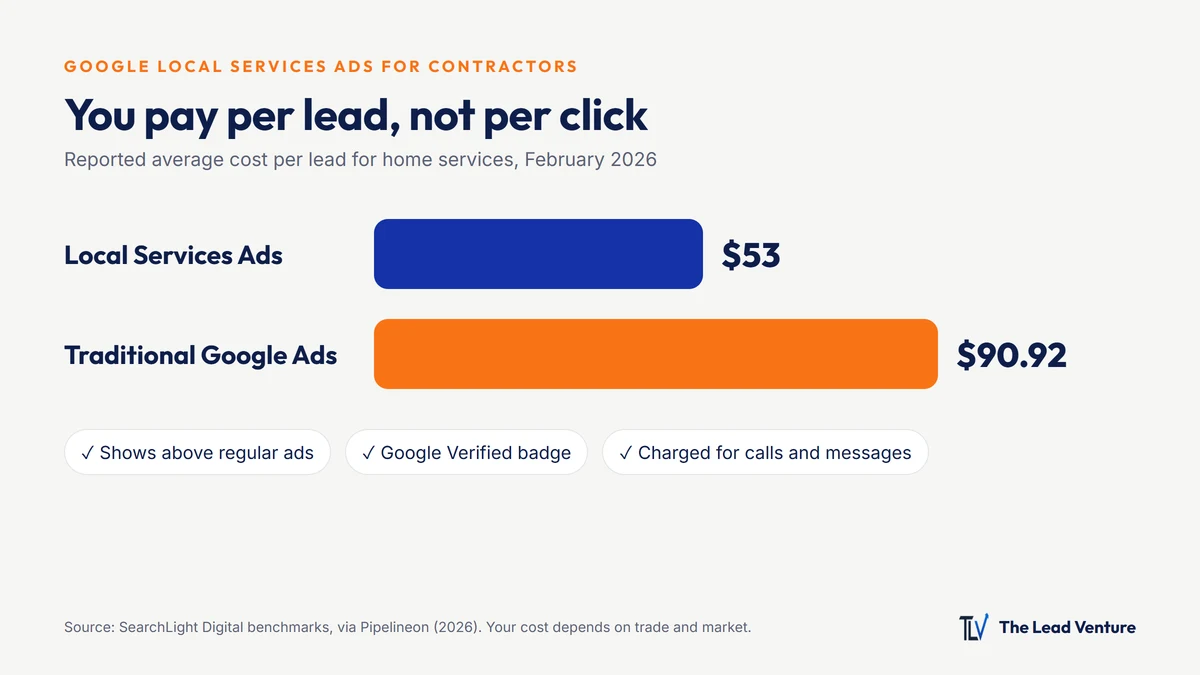
- You pay per lead, not per click. A lead is a call or message from a customer who found you through the ad. Google says you pay only for leads related to your business and the services you offer.
- You set a budget and choose the services and areas you want leads for.
- You must pass Google’s screening to show. Depending on your trade and location, that can include license, insurance and background checks.
- Your ad can show above regular Google ads for searches like “roofer near me.”
The Google Verified badge (what changed in 2025)
On October 20, 2025, Google replaced its separate badges (Google Guaranteed, Google Screened and License Verified by Google) with a single Google Verified badge. The money-back guarantee program that came with Google Guaranteed ended with it.
If your marketing still says “Google Guaranteed,” update it. Homeowners now see one badge that shows you passed Google’s checks.
What Local Services Ads cost
Google doesn’t publish a price list. Your cost per lead depends on your trade, your area and how many competitors are bidding.
For a rough benchmark, industry tracking reported an average of about $53 per lead for home services in February 2026, compared with about $91 per lead for traditional Google Ads. Emergency and high-ticket trades usually cost more per lead; lower-ticket services usually cost less.
As with any paid lead source, the price per lead isn’t the number that matters. What you pay per booked job is. Use the calculator in this post, and read our breakdown of whether Angi leads are worth it for the same math.
How Google ranks Local Services Ads
Google says LSAs are ordered by an auction that weighs your bid and your profile quality. The factors it lists include:
- Reviews and rating. Star rating and number of reviews affect your ranking.
- Responsiveness. How fast you respond to calls and messages. Google says missed calls may hurt your responsiveness.
- Profile quality. Photos, verification, business hours and your business details.
- Relevance and location. How well your services match the search, and where the customer is.
Local Services Ads reward the contractor who answers the phone. Every missed call costs you twice: the lead you paid for, and the ranking you need for the next one. That’s why missed-call text-back and fast replies matter even more here than anywhere else.
Are Local Services Ads worth it?
They usually are if:
- You answer the phone fast, or have a system that responds when you can’t.
- You have a solid review count and rating, or a plan to build one with review requests.
- You track every lead to a booked job, so you know your real cost per job.
- Your average job is big enough that $50 to $150 per lead still leaves room for profit.
They’re usually a struggle if you miss a lot of calls, have few reviews, or can’t tell which leads turned into jobs.
How to set up LSAs for success
- Complete Google’s screening and verification for your trade
- Choose only the services and areas you actually want
- Set accurate business hours, and answer during them
- Add real photos of your work, team and trucks
- Turn on missed-call text-back so no lead goes unanswered
- Ask every customer for a Google review
- Track each lead to booked, lost or no answer
- Review your cost per booked job every month
The bottom line
Local Services Ads can be one of the best paid lead sources for contractors, because homeowners call you directly and you pay per lead instead of per click. But they reward the businesses that answer fast and have great reviews. The Booked Solid System handles both: instant replies when you miss a call, and steady review growth to help you rank. Pair it with a strong Google Maps presence and you’re not depending on any one channel.