
Cutting Lead Response Time from 8+ Hours to Under 30 Seconds
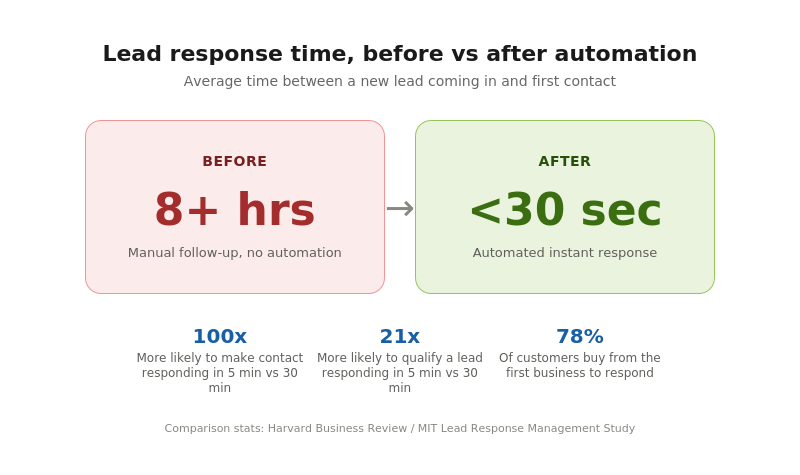
Before working with us, this client was responding to new leads whenever someone got around to it. After putting automated speed-to-lead systems in place, that response time dropped to under 30 seconds.
Why This Matters More Than Almost Anything Else
Speed to lead isn't just a nice-to-have metric, it's one of the most heavily studied and consistently proven factors in whether a lead ever becomes a customer.
Research from Harvard Business Review and MIT found that responding to a new lead within 5 minutes makes a business 100 times more likely to make contact and 21 times more likely to qualify that lead compared to waiting 30 minutes. And once you're past that window, it only gets worse, companies that respond within one hour are still 7 times more likely to qualify the lead than those that wait 24 hours, and 60 times more likely than businesses that wait a full day.
Most businesses treating leads as something to get back to "when they have time" are fundamentally misaligned with what people actually expect once they've reached out. An 8-hour response time isn't just slow, it's effectively invisible to a customer who already moved on to the next business in their search results.
What Was Happening Before
- Leads came in through the website, calls, and forms with no automated first response
- Whoever was available (or remembered to check) would follow up, often hours later
- By the time contact was made, many leads had already called a competitor or lost interest entirely
What We Did
- 1Built an instant automated response systemThe moment a lead comes in, whether from a missed call, a form fill, or a chat message, an automated message goes out immediately acknowledging them and starting the conversation.
- 2Routed leads to the right person instantlyInstead of sitting in a shared inbox waiting for someone to notice, leads are automatically routed and flagged so a real follow-up happens fast, not just an autoresponder and silence.
- 3Layered in missed call text-backAny call that isn't answered live triggers an immediate text, so even a missed call turns into an active conversation instead of a dead end.
- 4Set up ongoing monitoringResponse time isn't a one-time fix, it's tracked and maintained so it doesn't quietly drift back to the old normal.
The Result
| Metric | Before | After |
|---|---|---|
| Average lead response time | 8+ hours | Under 30 seconds |
Why This Matters
78% of customers buy from the first business that responds to them. An 8-hour delay doesn't just risk losing a lead, it hands that customer directly to whichever competitor happened to respond first. Going from 8 hours to under 30 seconds doesn't just improve a metric on a dashboard, it puts this business in position to win the vast majority of the leads it's already paying to generate, instead of quietly losing them to someone who simply answered first.
Stop Losing Leads to Slower Response Times
Find out how much revenue you're leaving on the table with missed calls and delayed follow-ups.
Get a Free Revenue Audit