 Jonathan Blake

Most contractors think they lose jobs on price. In reality, they lose most of them on speed.
Speed to lead is how fast you respond after someone reaches out. When a homeowner has a leaking pipe, a dead AC unit or a tree branch through their fence, they don’t call one company. They call three or four, and they hire whoever answers first with a real plan. If that’s not you, it doesn’t matter how good your work is. You never got the chance to prove it.
This post covers what speed to lead means, what the research actually says, what a good response time is, and the exact system to hit it when you’re on a roof. Want a quick read on where you’re losing calls right now? Take the 2-minute Growth Score Assessment.
Growth Score Assessment
A 2-minute assessment built for local home service businesses that shows where you are leaking leads and revenue.
- 12 quick multiple-choice questions
- Your top 3 priority fixes on the results screen
- Free, no credit card required
What is speed to lead?
Speed to lead is the time between a new lead reaching out and your first response. That lead might be a phone call, a missed call, a text, a form on your website, a Facebook lead or a Google message. It’s measured in minutes, sometimes seconds.
That’s the whole definition. It sounds simple. Most businesses still get it wrong, because the phone always seems to ring when you’re on a ladder, under a sink or driving between jobs.
What does the research say about lead response time?
“Respond in five minutes or lose the lead” gets repeated in every sales training. Most people quoting it have never read where it came from. Two studies get cited more than any others, and they’re worth knowing by name.
The 100x statistic: the Lead Response Management Study (2007)
The most quoted speed to lead numbers come from the Lead Response Management Study by InsideSales.com and Dr. James Oldroyd, often called “the MIT study.” It analyzed more than 15,000 web leads and over 100,000 call attempts, looking at when calls were made and how often they reached and qualified the person.
Its key findings:
- The odds of contacting a lead were 100 times higher when called within 5 minutes versus 30 minutes.
- The odds of qualifying a lead were 21 times higher within 5 minutes versus 30 minutes.
- The odds of making contact dropped by over 10 times in the first hour.
- Wednesdays and Thursdays were the best days to reach leads, and 4 to 6pm was the best time to make contact.
The lesson: the first few minutes after someone reaches out are worth more than the next several hours combined.
The response gap: Harvard Business Review (2011)
A separate study, published in Harvard Business Review as “The Short Life of Online Sales Leads,” sent test web leads to 2,241 U.S. companies and timed how fast they responded.
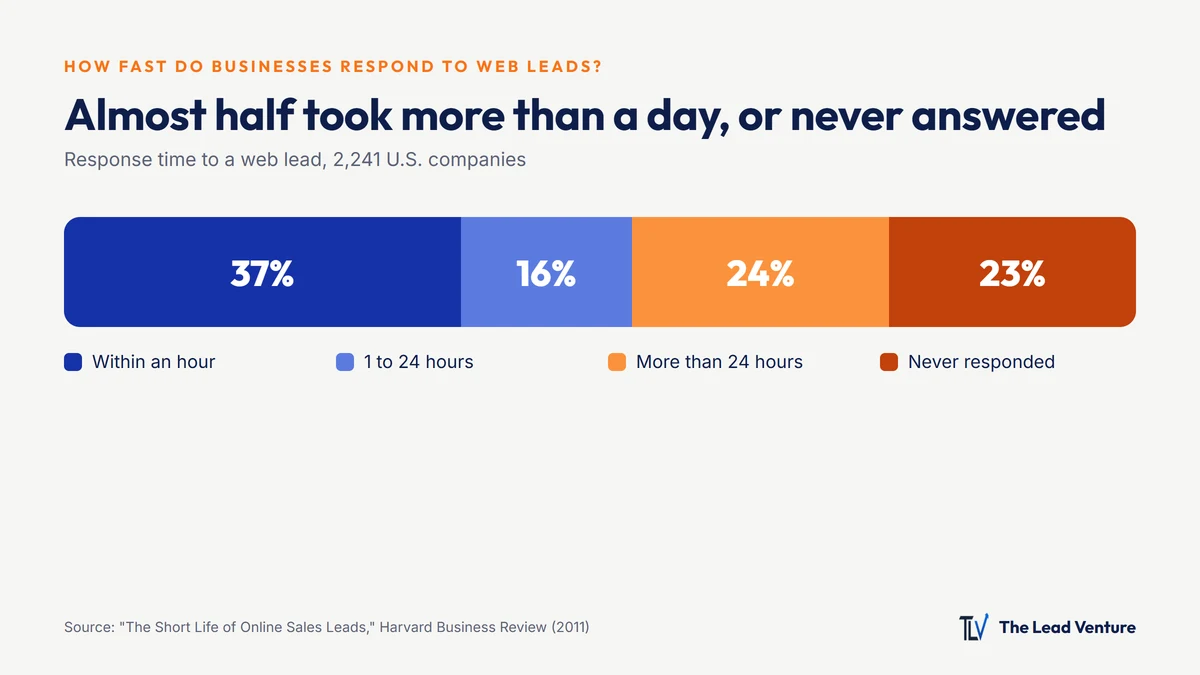
- 37% responded within an hour.
- 16% responded within 1 to 24 hours.
- 24% took more than 24 hours.
- 23% never responded at all.
- Among companies that did respond within 30 days, the average response time was 42 hours.
Are these speed to lead statistics still accurate?
Both studies are more than a decade old and covered many industries, not just home services. Buying habits have changed since then, and more people text instead of call. Treat the exact multiples as directional, not as a promise.
What hasn’t changed is the direction. Faster responses reach more people and book more jobs. Our own speed-to-lead case study shows the same thing.
Why do contractors lose leads to the clock?
Most businesses don’t lose leads to competitors. They lose them to the clock. A homeowner with a leaking pipe or a broken AC isn’t waiting 42 hours. They call the next company on the list.
It’s not because contractors don’t care. It’s because the call comes in at 2pm while your hands are covered in grease. It goes to voicemail, the homeowner hangs up without leaving a message, and you never even know you lost the job.
That’s why missed calls are the real leak, not weak marketing. If you’re missing even one in five calls and nobody follows up fast, you’re paying to generate leads that disappear before your team ever talks to them. More ad spend won’t fix that. It just means you lose more leads, faster.
The good news is in the same data. The average business takes nearly two days, and almost a quarter never respond. The fastest way to beat the average is to answer. You don’t need to be bigger or cheaper. You need to be first.
What is a good lead response time for a contractor?
Within 5 minutes for a real response, and within seconds for the first automatic touch. Here’s how we set the targets for our clients:
| Lead type | First response | Real person follows up |
|---|---|---|
| Call you answer live | Right away | Right away |
| Missed call (business hours) | Text in seconds | Within 5 minutes |
| Web form or Facebook lead | Text or email in seconds | Within 5 minutes |
| Text or Google message | Reply in seconds | Within 5 minutes |
| After hours | Text or AI answer in seconds | First thing next morning, or sooner for emergencies |
In our own sales work, the standard is a reply in under 60 seconds and an appointment the same day or next day, because interest fades fast. More on what that produced below.
How do you respond in 5 minutes when you’re on a roof?
The fix isn’t “answer every single call.” That’s not realistic when you’re running a crew. The fix is making sure a lead never goes silent, even when you can’t pick up. These are the pieces, from simplest to most hands-off.
1. Missed-call text-back on every unanswered call
The instant you miss a call, the caller gets a text from your business number. It tells them you saw their call, so they don’t assume you’re ignoring them, and it gives them a way to reply by text if calling back isn’t convenient. Missed-Call Text-Back runs 24/7, including nights and weekends. Our missed call text back setup guide walks through it step by step.
2. An AI Voice Agent that answers the call live
Text-back catches the call after it’s missed. An AI Voice Agent picks up so it isn’t missed at all. It answers in your business name, asks what the homeowner needs, and can book the appointment while you finish the job. If you’re weighing this against a human service, read AI receptionist vs. answering service.
3. Conversation AI to carry the text conversation
When the homeowner texts back, someone has to answer. Conversation AI replies to texts, website chat and social messages, asks the qualifying questions, and books the job, so the conversation doesn’t stall until you’re off the roof.
The AI Voice Agent and Conversation AI come with the AI Receptionist + AI Sales Rep add-on for Full Suite clients of the Booked Solid System ($197/month, usage billed at cost). Missed-call text-back is included in both plans.
4. Instant replies to web forms and Facebook leads
The same rule applies to anyone who fills out a form on your website or a Facebook lead ad. An automatic first reply sent within seconds, not hours, keeps that lead warm while you finish the job you’re on.
5. One inbox and an alert to a real person
Calls, texts, forms, Facebook and Google messages should land in one inbox, not five apps. Whoever owns sales at your company should get a phone alert the moment a new lead comes in, so a real person can jump in while it’s still hot instead of finding it at the end of the day.
Speed to lead templates and scripts you can copy
Automation buys you time. What it says still matters. Keep it short, sound like a person, and ask one question.
Callback script: once you do call back, even if it’s 20 minutes later instead of 5, how you open the call matters.
That script identifies you clearly, apologizes briefly without over-explaining, and gets straight into helping. No pitch, no filler. For more versions by trade and situation, see our missed-call text-back templates. Only text people who contacted you or gave you permission.
What happens after the first response?
Speed gets you the conversation. The conversation gets you the job. Once you’ve reached the homeowner, the same urgency carries into the appointment and the follow-up:
- Book same-day or next-day appointments. Interest fades fast, so get the estimate on the calendar while they still care.
- Get both decision-makers at the table so you don’t hear “I need to talk to my spouse.”
- Follow up on anyone who doesn’t book. A lead that goes quiet isn’t a no. Here’s how to follow up after an estimate.
This is the process I sell with. I’ve personally sold over $1 million in 2026 so far. In September 2026, selling for a Toledo-area lawn maintenance and hardscape company, we replied to leads in under 60 seconds, ran same-day or next-day appointments, and closed $111,803 in estimates at a 61% close rate for the month. Our Lead Nurture and Appointment Setting playbooks cover the follow-up in detail.
How do you measure speed to lead?
Most owners guess. Test it instead. This costs nothing and takes five minutes to set up:
- Have a friend or family member call your business number and hang up before you answer.
- Time how long it takes for any response, text or call, to reach them.
- Do the same test with a form submission on your website, and again after hours.
- Write down every number.
If any number is longer than 5 minutes, you have a real, fixable leak, and now you know how big it is.
Then track it every month. Look at the time from a lead coming in to the first response, and to the first real conversation with a person. Break it out by source (calls, forms, Facebook, Google) and by business hours vs. after hours, since that’s where most leaks hide.
To put a dollar figure on it, use the calculator in this post. The Revenue Leak Finder shows the other leak: what no-shows and weak follow-up cost you each month.
What changes when you fix speed to lead?
Businesses that fix speed to lead don’t necessarily spend a cent more on ads. They just stop losing the leads they’re already paying for. That’s usually the fastest, cheapest win available to a local service business: faster than a new website, a rebrand or a new marketing channel.
We’ve seen it with our own clients. In one case, we took a client’s lead response time from 8+ hours to under 30 seconds with instant automatic replies, lead routing, missed-call text-back and ongoing monitoring so it didn’t drift back.
Your speed to lead checklist
- Turn on missed-call text-back so every unanswered call gets a text in seconds
- Send an instant reply to every web form and Facebook lead
- Decide who answers live calls when you can’t, a person or an AI Voice Agent
- Put calls, texts, forms and Google messages in one inbox
- Get new-lead alerts on your phone, not just your email
- Set a rule: every lead gets a real response within 5 minutes during business hours
- Use templates so replies sound like a person
- Book estimates same day or next day, then follow up after the estimate
- Run the call-and-hang-up test, and check your response time every month
Quick wins
Want leads this month? Start here
Build the foundation first. A good website, local SEO and citations, plus every profile you can claim: Google, social media, search engines and directories. Keep your NAP (business name, address and phone number) exactly the same on your website and every listing. Verify your site in Google Search Console and Bing Webmaster Tools, and claim Bing Places for Business. The more digital real estate you own, the farther everything below takes you.
Hit up past customers
Send everyone you've worked for a real offer. They already trust you, so it's the fastest money on the board.
Do cold outreach
Call, text (with consent), email or walk in to the people and businesses who buy what you sell.
Run ads
Put a simple offer in front of homeowners in your service area this week.
Post content
Before-and-after photos, short videos and quick tips on your Google profile and social pages.
Partner with businesses that own your customers
Adjacent companies already serve the people you want. When they recommend you, you borrow their authority and trust. Co-market, swap leads or partner on lists (and follow the consent rules).
Answer every lead in under a minute
The faster you reply, the more you close. Wait 2 to 5 minutes and many leads have already called someone else.
Work every job's neighborhood
- Canvass the neighborhood around every job site. Knock on the doors on both sides and across the street.
- Leave a door hanger at every house you don't catch at home.
- Drop a handwritten note or card at the neighbors' doors: sorry for the noise and the trucks, plus an offer for a free inspection or quote.
- Put a yard sign in front of every job, and at the entrance of neighborhoods where you've done work (with permission).
Ask for introductions, not referrals
"Do you know anyone who needs…?" gets a polite "I'll keep you in mind." Asking for an introduction to a specific person gets names. Set it up at the sale, before the work starts:
"Most of our customers come from introductions, about [your real number, like 80 to 90] percent. If we knock it out of the park for you, would you be against introducing me to anyone you know who might need the same work? We'll give them a free estimate."
Then follow up after the job. If you've built real rapport with the customer, a little humor works:
"So do you hate me, or do you hate your friends? Why haven't you left a review or introduced me to someone who needs the same work yet?"
Only joke like that with customers you know well. With everyone else, keep it simple and thank them either way.
The bottom line
The research is old, but the lesson keeps holding up: the business that answers first usually gets the conversation, and the conversation is how you get the job. You don’t have to answer every call yourself. You need a system that responds in seconds and a person who follows up in minutes. The Booked Solid System is built around exactly that, even when you’re on a roof.