 Jonathan Blake
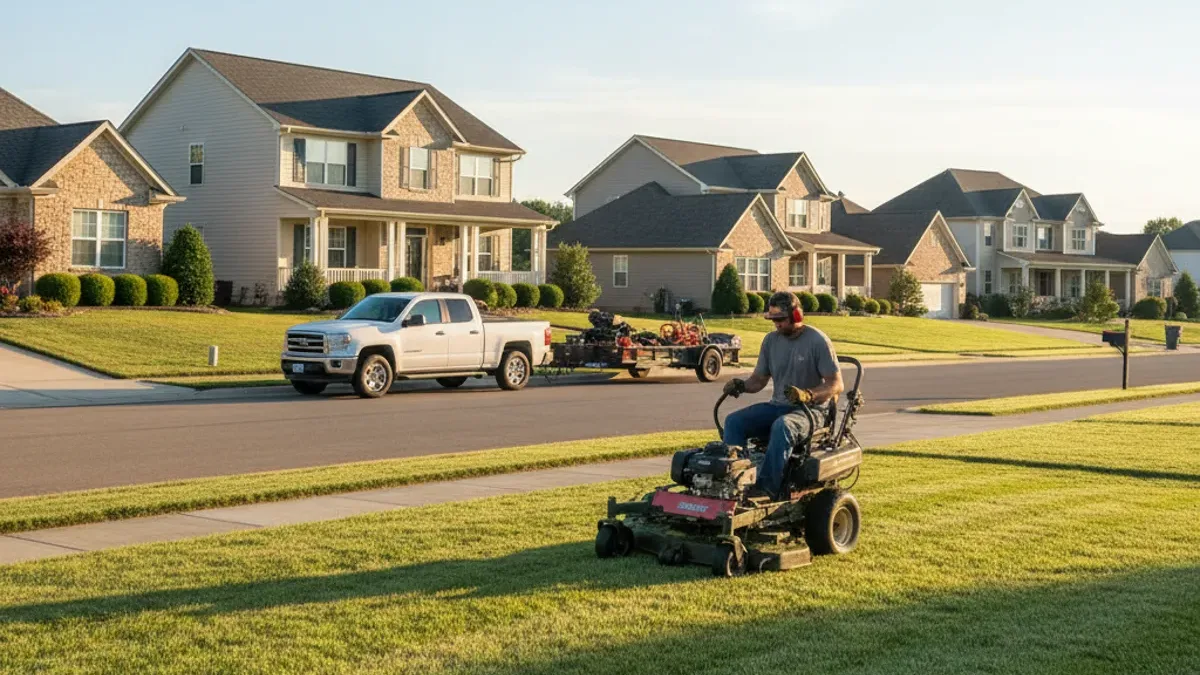
Most lawn care marketing advice is about getting more leads. But a lead 25 minutes past your last stop isn’t much of a win. You burn fuel and crew time driving to it, and it makes every route day longer. Ten new lawns scattered across the county can make you less money than five on one street.
So these lawn care marketing ideas all aim at the same thing: route density, meaning more customers on the streets you already drive. They’re in roughly the order they pay off. Not sure where your business is leaking the most? The 2-minute Growth Score Assessment will point you to it.
1. Pick your target area and say no to the rest
Before you spend a dollar on marketing, draw the map. Pick the neighborhoods where you already have the most lawns and where the yards fit your equipment and pricing. That’s where every idea below should point.
You don’t have to turn down every lawn outside it. Just price the drive time into anything outside your area, and don’t spend marketing money there. Tight routes are where the profit is.
2. Run the 12 Pack around every lawn you mow
The cheapest lawn to add is the one next door to a lawn you already mow. Your crew is already on the street, the neighbors can see the work, and adding a stop costs you minutes, not a new drive.
The 12 Pack is our system for turning one job into a neighborhood campaign: seven touches over 90 days, all with the same offer and deadline. Before the job, text past customers in that zip code who’ve agreed to hear from you, then knock on the 12 or more homes around the job. During the job, a yard sign and your branded trucks. After, another knock, a before-and-after door hanger, then mail at 30 and 90 days. The full breakdown is in the 12 Pack section of our fundamentals playbook.
Knocking on doors works when you keep at it. On residential home exteriors, our co-founder Tye Norden generated 576 door-knocking leads at a 26% contact rate. That wasn’t lawn care, but the same rules apply: show up, be brief, and give the neighbor a reason to say yes today.
12 Pack ROI Calculator
See how many extra deals one job can bring in when you work the whole neighborhood before, during and after the job.
- Plug in your own close rate and average job
- Includes the full 12 Pack playbook
3. Leave a door hanger that points to the lawn next door
A generic flyer gets tossed. A door hanger that says “We take care of the Johnsons’ lawn three doors down” gets read, because the neighbor can walk outside and look at the work.
Get the customer’s OK before you use their address or name. Most happy customers don’t mind, and plenty like being the reason a neighbor’s yard looks better.
4. Put a yard sign on every lawn that will take one
A yard sign is the cheapest ad you’ll ever buy. Ask every new customer if you can put one up for a week or two after the first service or a big cleanup, when the yard looks its best. Keep it simple: your name, what you do, and a phone number or QR code people can use from the sidewalk.
5. Mail the routes you already drive with EDDM
USPS Every Door Direct Mail lets you mail every address on a carrier route without buying a mailing list. USPS says the pieces are simply addressed to “Postal Customer,” and you pick the neighborhoods in its EDDM Online Tool. For EDDM Retail, USPS lists postage at $0.26 per piece and a range of 200 to 5,000 pieces per day per ZIP Code, as of November 2026. Check usps.com for current rules before you print.
EDDM for lawn care
Pros
- No mailing list to buy
- You pick the exact carrier routes
- Every house on a street you already mow gets the card
Cons
- Every door means renters and apartments too
- Printing and postage add up per piece
- One card rarely works alone, so plan a second
Mail the routes where you already have customers, not the whole city. Pick the same carrier routes your crews drive, then send a second card a few weeks later. If a solo postcard is too expensive, a shared card can split the cost. We designed the Homefront Savings Card, one mailer with 14 local businesses, one per trade, each with its own tracking number and QR code.
6. Get your Google profile right and ask for a review after every job
When a homeowner searches “lawn care near me,” the map pack decides who gets the call. Google says local results are based mainly on relevance, distance and prominence, and that reviews can help.
- Set your primary category to lawn care and list every service you actually offer: mowing, fertilization, weed control, aeration, overseeding, cleanups.
- Set your service area to the neighborhoods from idea #1.
- Add real photos of your crews and lawns every month.
- Ask every customer for a review the same way, by text, with a one-tap link. Never pay for reviews, offer rewards for them, or only ask the happy customers.
Use our Google review request text templates, and see our landscaping SEO guide for the full Google and website routine.
7. Answer every lead before the next lawn company does
Homeowners looking for lawn care usually ask more than one company for a price. The first one to reply with a real number usually gets the job. When we sold lawn maintenance and hardscape work for a Toledo-area company, our goal was a reply in under 60 seconds and an estimate the same day or the next. That month we sold $111,803 at a 61% close rate.
You can quote most mowing jobs from a satellite map the same day. Set up missed-call text-back and an automatic reply to web forms so nobody waits while you’re on a mower.
8. Run a limited offer for one zip code in March
March is when homeowners start thinking about their lawn and before most of them have signed with anyone. A specific, limited offer gives them a reason to sign with you now instead of collecting quotes in April.
Why it works:
- It’s specific. One zip code, one deadline, 10 spots. Pick a zip where you already have lawns, so every new customer tightens a route.
- It’s real. Only offer what you’ll honor, use your actual price for the “value,” and stop at 10. A limit you don’t enforce stops working the second time.
- It leads to the bigger sale. The free month is the door. The goal is a 12-month agreement: lawn care through the season and, in the Midwest, snow removal through the winter, so you keep the customer (and the revenue) all year.
Once they’re on a 12-month agreement, the next step is selling them more of what they need.
9. Sell the next service to the lawns you already have
Your current customers already trust you, and you’re already in their yard. Every extra service you sell them is revenue with no added drive time.
- Spring: cleanups, mulch and the first fertilizer application.
- Late summer and fall: aeration and overseeding, then fall cleanup and leaf removal.
- Winter in the Midwest: snow removal. Sell it in the fall to customers who already pay you all season. Here is how to sell snow contracts.
Text your mowing list about each one a few weeks before the season. Our lawn care upsell playbook has the full plan. It’s how we sell for Integrity Lawn & Landcare: a lawn customer is a mulch customer, and a mulch customer is a fertilization customer.
10. Reactivate past customers and last year’s quotes
Every lawn care company has a list of people who used to be customers, or got a quote and never signed. That list is worth more than you think. We ran a reactivation campaign for a client on a list of 1,200 contacts that was more than three years old, and that one campaign brought in $18,000 in revenue.
Start in late winter, before your competitors’ spring push. Give them a real offer with a real deadline. Only text people who agreed to hear from you; email the rest. Copy our database reactivation campaign texts.
11. Go after commercial contracts in the winter
Apartment complexes, HOAs and office parks give you a full season of work at one stop, often with snow removal on top. They don’t come from your website. In early 2026 I visited more than 250 apartment complexes over 10 weeks for a landscaping company, and that campaign signed 26 commercial properties and $176,346 in lawn maintenance contracts. The step-by-step is in how to get commercial lawn care contracts.
Same rule as residential: go after properties near your existing routes first.
12. Ask for introductions, not referrals, and pay cash for them
“Do you know anyone who needs lawn care?” almost always gets “I’ll think about it.” Customers can’t picture who to send you. Ask for an introduction to someone specific instead:
“We’re adding a few more lawns on your street this season. Who are the neighbors you’d want to see on our schedule? I’d love an introduction.”
Then make it worth everyone’s time with a cash referral program that’s a win, win, win:
- Your customer wins cash when the neighbor signs a season agreement. Cash gets a lot more attention than a coupon or a free mow.
- The neighbor wins a discount on their first month, and gets a lawn company their neighbor already trusts.
- You win a new customer on a street you already mow, at a lower cost than any ad.
How much cash should you pay per referral?
Base it on what a customer is worth to you (lifetime value, or LTV) and what you can afford to spend to get one (customer acquisition cost, or CAC). A common rule of thumb is to keep LTV at least 3 times CAC.
Here’s an example. Use your own prices and margins, and price for profit first: set a mowing minimum of at least $50 to $60 a cut (higher in many markets), and aim for at least a 70% gross margin on your services.
| Example numbers | Weekly mowing customer |
|---|---|
| Price per cut | $55 |
| Cuts per season | 32 |
| Mowing revenue | $1,760 |
| Spring and fall cleanup ($300 each) | $600 |
| Revenue per year | $2,360 |
| Years they stay | 3 |
| Lifetime revenue | $7,080 |
| Gross margin | 70% |
| Lifetime gross profit (LTV) | $4,956 |
| Most you should spend to get one (LTV ÷ 3) | $1,652 |
Cut counts, cleanup prices and add-ons vary a lot by market, and many customers buy more (fertilization, aeration, mulch). With these numbers you could pay up to $1,652 for a new customer and still keep a healthy 3:1 ratio. A referral program costs far less than that:
- $100 cash to your customer + $50 off the neighbor’s first month = $150 per new customer. That’s an LTV to CAC ratio of about 33 to 1.
- $250 cash + $100 off = $350. Still about 14 to 1, and a big enough number that customers actually start introducing you.
- On a 12-month lawn and snow agreement, lifetime value goes up, so you can pay even more. If snow adds $800 in gross profit a year, three years adds $2,400, and the same $150 referral becomes roughly 49 to 1.
Pick an amount people will notice, then check it against your numbers with the calculator in this post or our customer acquisition cost guide. Pay it only when the neighbor signs and pays for their first service.
Put the program on every invoice, in your end-of-season message and on a card you leave after every service. Pay quickly when someone qualifies, and tell the customer when you do. Fast payouts are what get them to introduce you again.
Nextdoor is where neighbors ask “who do you use for your lawn?” Claim your free Business Page and ask happy customers to recommend you there. Read Nextdoor for contractors before you post.
Track cost per new customer, by neighborhood
Every idea above should earn its keep. Track how many new customers each one brings in, what it cost, and which neighborhood they’re in. A channel that adds customers on your routes is worth more than a cheaper one that adds them across town. The calculator in this post shows your cost per new customer.
Your lawn care marketing checklist
- Target area drawn on a map, with drive time priced in outside it
- 12 Pack run around every new lawn
- Door hangers that name the job next door (with the customer’s OK)
- Yard sign asked for on every new lawn
- EDDM card mailed to the carrier routes you drive
- Google profile complete, with a review request after every job
- Every lead answered within minutes and quoted the same day
- Aeration, overseeding, fall cleanup and snow offers sent to your mowing list
- Past customers and last year’s quotes contacted before spring
- Commercial list built and worked in winter
- A March offer for one zip code, limited to the first 10 customers
- New customers moved onto 12-month lawn (and snow) agreements
- Cash referral program on every invoice, with introductions asked for by name
- Cost per new customer tracked by channel and neighborhood
Overlooked money
Bid on city and government contracts for lawn care and snow removal
Cities, counties, schools and federal agencies hire local companies every year, and many small contractors never bid. There's a lot of money out there for the ones who sign up.
One client example: we helped a lawn care company win a city contract worth $193,500 this year, with the option to renew for 3 years plus snow removal, at about a 65% gross margin. We signed them up on PlanetBids, SAM.gov and their local government's vendor list.
One client's result; not typical or guaranteed. Contract terms and margins vary.
- 1
Start with your local government
Check your city, county, school district and park district websites for a bids, procurement or vendor registration page, and register as a vendor.
- 2
Sign up on bid platforms
Many local agencies post bids on platforms like PlanetBids. Create a free vendor profile and set alerts for your service categories.
- 3
Register on SAM.gov for federal work
Federal contracts require a SAM.gov registration, which is free. It takes some paperwork, so start before you need it.
- 4
Read every bid packet carefully
Insurance minimums, bonding, prevailing wage, scope and deadlines are all spelled out. Miss one requirement and the bid gets tossed.
Requirements differ by agency and contract. Read each bid's rules, and talk to your insurance agent and accountant before you bid on public work.
Quick wins
Want leads this month? Start here
Build the foundation first. A good website, local SEO and citations, plus every profile you can claim: Google, social media, search engines and directories. Keep your NAP (business name, address and phone number) exactly the same on your website and every listing. Verify your site in Google Search Console and Bing Webmaster Tools, and claim Bing Places for Business. The more digital real estate you own, the farther everything below takes you.
Hit up past customers
Send everyone you've worked for a real offer. They already trust you, so it's the fastest money on the board.
Do cold outreach
Call, text (with consent), email or walk in to the people and businesses who buy what you sell.
Run ads
Put a simple offer in front of homeowners in your service area this week.
Post content
Before-and-after photos, short videos and quick tips on your Google profile and social pages.
Partner with businesses that own your customers
Adjacent companies already serve the people you want. When they recommend you, you borrow their authority and trust. Co-market, swap leads or partner on lists (and follow the consent rules).
Answer every lead in under a minute
The faster you reply, the more you close. Wait 2 to 5 minutes and many leads have already called someone else.
Work every job's neighborhood
- Canvass the neighborhood around every job site. Knock on the doors on both sides and across the street.
- Leave a door hanger at every house you don't catch at home.
- Drop a handwritten note or card at the neighbors' doors: sorry for the noise and the trucks, plus an offer for a free inspection or quote.
- Put a yard sign in front of every job, and at the entrance of neighborhoods where you've done work (with permission).
Ask for introductions, not referrals
"Do you know anyone who needs…?" gets a polite "I'll keep you in mind." Asking for an introduction to a specific person gets names. Set it up at the sale, before the work starts:
"Most of our customers come from introductions, about [your real number, like 80 to 90] percent. If we knock it out of the park for you, would you be against introducing me to anyone you know who might need lawn care? We'll give them a free first mow."
Then follow up after the job. If you've built real rapport with the customer, a little humor works:
"So do you hate me, or do you hate your friends? Why haven't you left a review or introduced me to someone who needs lawn care yet?"
Only joke like that with customers you know well. With everyone else, keep it simple and thank them either way.
The bottom line
Lawn care marketing works best when it fills the streets you already drive. Work the neighborhood around every lawn, answer fast, sell the next service and stay in touch after the season ends. Browse our lawn care growth playbooks, see how we handle lawn care marketing and SEO, and let the Booked Solid System handle the fast replies, follow-up and review requests for you.