 Jonathan Blake
I started a tree service in 2015 and ran it for six years. I didn’t come from a marketing background. I grew up severely dyslexic, and I learned marketing the only way I could, by doing it, getting it wrong, and fixing it on the next job.
So this isn’t a list of marketing ideas for tree service companies pulled from a software company’s blog. It’s what actually brings in tree work: getting found on Google, answering storm calls, staying busy in winter, and turning one job into the next five. If you want to know where your business is leaking leads right now, the 2-minute Growth Score Assessment will point to your biggest gap.
What is the best local tree service marketing?
The best tree service marketing makes you easy to find, easy to trust and easy to reach. In practice, that means:
- A complete Google Business Profile with your services, service area and real photos.
- Reviews that keep coming in after every job.
- A simple website that shows your work, your insurance and how to get an estimate.
- Answering every call fast and booking the appointment right away, especially during storms.
- Following up on every estimate until you get a yes or a no.
- Getting work from the people around your jobs: neighbors, landscapers, roofers, insurance agents and property managers.
- Content marketing: video and live streams from your job sites.
Tree work is sold on trust, and trust is built before the homeowner ever calls you. Someone is letting you drop a 70-foot oak next to their house. They want to know you’re insured, you know what you’re doing, and you’ll show up. Everything below is about proving that.
Content marketing: film the work and go live
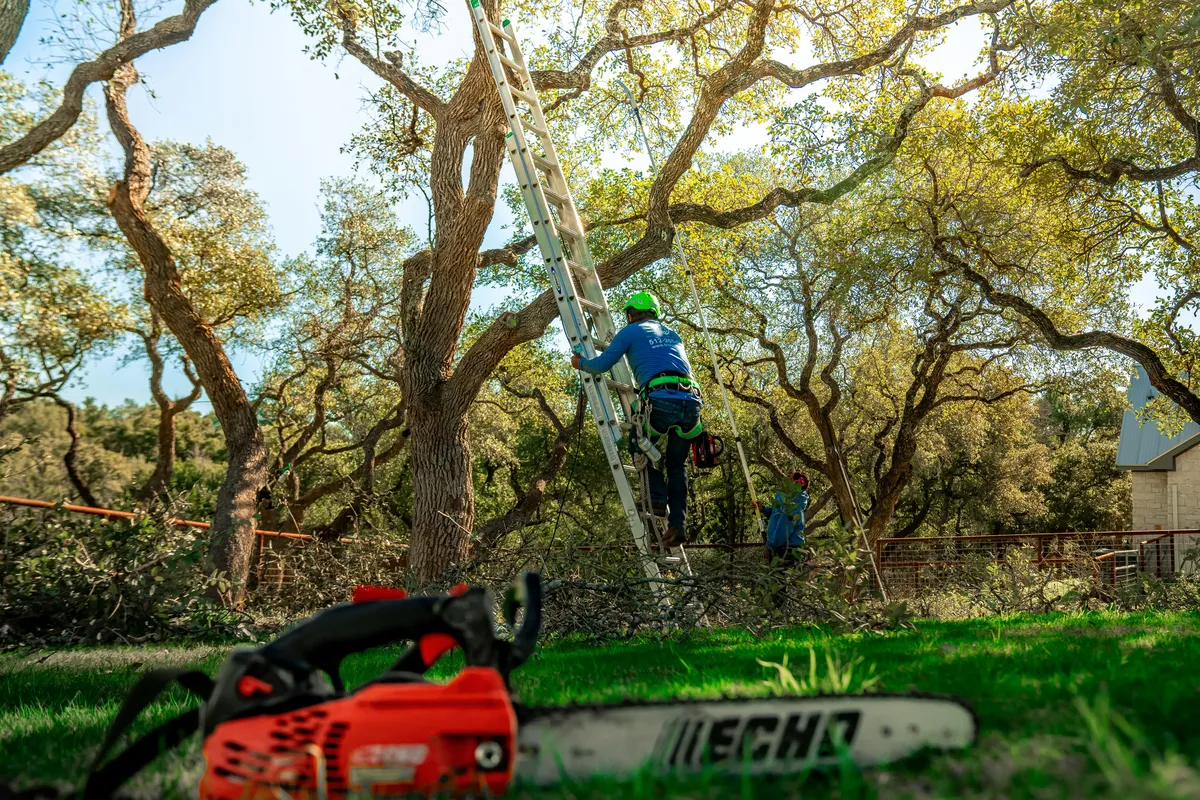
Tree work is some of the most watchable content in the trades. I shot a lot of video and did a lot of live streams, and I’d talk to people watching while I went back and forth cutting trees down. Viewers asked questions, and some of them turned into estimates. You don’t need fancy gear. A phone on a tripod, a big removal, and someone narrating what’s happening and why is enough.
Post it everywhere you can: Facebook, Instagram, TikTok, YouTube and your Google Business Profile. The more people see your crew working safely, the more they trust you before they ever call.
When it’s slow, do warm outreach
When work slowed down, I reached out to people I knew and asked if they knew anybody who had tree work. I also messaged everyone who interacted with my content, something like:
A fair amount of the time, they asked for a quote themselves or sent me to someone who needed work.
How do you get your first tree service customers?
When you’re starting out, you don’t have reviews, a big website or an ad budget. You have a truck, a saw and the jobs you can see.
Knock doors around every job
Every tree job is an advertisement. The neighbors hear the chipper and watch the crane. Some of them have a dead ash or a limb over the roof they’ve been meaning to deal with.
Over the years I’ve knocked roughly 25,000 doors and personally closed more than 1,000 leads, and the doors next to an active job are the warmest ones you’ll ever knock. Keep it short:
Hi, I’m Jonathan with [Company]. We’re taking down the tree at the Millers’ place next door today. While the crew is here, I’m giving free estimates on the street. Anything you’ve been worried about?
If nobody answers, leave a door hanger with a photo of your crew and your number.
Door knocking near tree jobs
Pros
- Costs nothing but time
- Neighbors can see your crew and equipment working
- Jobs on the same street save drive time and setup
- Great for a new company with no reviews yet
Cons
- Takes real time away from running the crew
- Some towns have solicitation rules, so check yours
- Rejection is constant, and you need thick skin
Tell everyone you know
Your first jobs usually come from people who already trust you: friends, family, former coworkers, your church, your kid’s team. Ask them directly who they know with a tree problem. That’s not pushy. It’s how almost every trade business starts.
Set up your Google Business Profile on day one
You don’t need a storefront. Google’s guidelines say service-area businesses should hide their address and list the areas they serve instead. Fill in every service you offer (tree removal, trimming, stump grinding, storm cleanup, emergency tree service) and add photos from the jobs you’ve done, even if it’s only a handful.
How do you get more tree service leads from Google?
For most companies, tree service digital marketing starts and ends with Google. Google says local results are based mostly on relevance, distance and prominence. You can’t move your shop closer to every customer, but you can control relevance and build prominence.
- Relevance: List every service in plain words. If you grind stumps, say stump grinding. If you do emergency storm work, say that too. Pick the primary category that best describes your business.
- Prominence: Reviews, photos, and mentions of your business around the web. Real job photos (before, during and after) work well for tree service because the transformation is so visual.
- Accuracy: Keep your phone number, hours and service area consistent everywhere you’re listed. Don’t stuff keywords into your business name. Google’s guidelines prohibit it and it can get your profile suspended.
Then build a website that backs it up. At minimum: a page for each main service, a service-area page, your proof of insurance, job photos and a short estimate form. Our Google Business Profile checklist walks through the setup step by step, and local SEO for contractors covers the website side.
If you want paid leads, Google Local Services Ads include a tree services category in the US. You pay per lead instead of per click, but you have to pass Google’s screening. Our Local Services Ads guide explains how it works and when it pays.
Should you show your ISA certification in your marketing?
Yes, if you or someone on your crew holds it. An ISA Certified Arborist credential tells a homeowner you passed a real exam in tree care, and it separates you from the guy with a pickup and a chainsaw.
Show it everywhere: your website, your Google Business Profile description, your estimates and your truck. Then make it easy to check.
If nobody on your team is certified yet, don’t imply that you are. Talk about your insurance, your equipment, your safety practices and your years in business instead.
How do you market tree service during storm season?
Storms are when the phone rings the hardest, and they’re also when tree companies lose the most leads. Your crew is on a job, your phone is in the truck, and the homeowner with a tree on their garage calls the next company on Google.
The tree company that answers first during a storm usually gets the job, and often the customer for years after. A few things to have ready before the wind hits:
- Missed-call text-back. If you can’t pick up, the caller gets a text right away saying you got their call and will reach them shortly. Our missed-call text-back templates give you the words.
- A storm triage script. Is anyone hurt? Is the tree on the house, a car, or a power line? Power lines go to the utility, not your crew. Is it blocking a driveway? Book the dangerous jobs first.
- Photo estimates. Ask callers to text photos so you can price and prioritize without driving to every address.
- A storm post on your Google Business Profile saying you’re taking emergency calls and which areas you’re covering.
My storm playbook went heavy on every channel at once:
- EDDM mail before, during and after the storm. Every Door Direct Mail goes to every house on the carrier routes you pick. The mail usually still comes when the power and internet are out, so a postcard can reach people your ads can’t.
- Heavy ads in the areas that got hit, as soon as it’s safe to work.
- Signs everywhere you’re allowed to put them, and on every job site.
- A lot of doors. Knock the streets around every storm job. Neighbors with the same damage are standing in their yards looking at it.
Then lock the work in:
One more caution for storm season:
Storm work also attracts out-of-town crews who leave a mess and a bad name. Be the local company that’s still there next month: clear pricing, proof of insurance, and a real follow-up. Roofers face the same problem, and our post on storm lead generation for roofers covers how to win storm jobs without the pushy tactics.
How do you keep a tree crew busy in the winter?
Sell dormant-season pruning. When leaves are off, you can see the whole structure of the tree. University of Illinois Extension notes that pruning in the dormant season gives an increased view of the tree’s shape and enough time for proper wound closure.
That’s a real reason for a homeowner to book in December or February, not just a discount. Here’s how to sell it:
- Reach out to past customers in late fall with a pruning offer and a reason: better visibility, less stress on the tree, and a crew that can get to them before spring.
- Walk the property on every winter removal and point out other trees that could use pruning.
- Know the exceptions. The same Illinois Extension article says oaks shouldn’t be pruned from March through October to reduce the spread of oak wilt. Telling a homeowner that builds more trust than any ad.
Other ways we kept the crew working in winter:
- Snow removal. Trucks, crews and customers you already have. Our snow removal marketing guide covers selling snow contracts.
- Traveling for storms. When storms hit other areas, we’d go where the work was.
- A different seasonal service, like installing Christmas lights. Your crew already has the ladders and the comfort with heights.
- Going where there’s need. If we had time, we’d go to places that needed help after bad weather.
Seasonal pushes like this are easier when you plan them ahead. Our seasonal marketing ideas post has a calendar you can borrow.
Who makes the best tree service referral partners?
Some of the best tree leads come from people who see tree problems before the homeowner calls anyone.
Insurance agents
- What they see: Storm claims, trees on houses, policyholders asking who to call
- What they want: A reliable, insured company they can recommend without worrying
- How to start: Drop off your certificate of insurance and a short info sheet
Landscapers and lawn companies
- What they see: Dead trees, low limbs and stumps on every property they mow
- What they want: Someone to hand tree work to who won't steal their lawn customers
- How to start: Agree to send each other work and stay in your lanes
Property managers
- What they see: Trees over parking lots, buildings and sidewalks across many sites
- What they want: Fast response, clean job sites and proof of insurance
- How to start: Visit in person and offer a free tree walk of their property
Roofers
- What they see: Limbs over roofs, storm damage and trees that keep wrecking shingles and gutters
- What they want: A tree company that clears the way so they can start the roof
- How to start: Offer to handle their tree removals fast and send roof leads back
Property managers take more work, but the accounts can be big. In early 2026 I spent 10 weeks driving more than 8,000 miles to visit over 250 apartment complexes for a landscaping company. That campaign signed 26 commercial properties and $176,346 in lawn maintenance contracts (one campaign; not typical or guaranteed). The same approach works for tree work: show up, win over the front desk, and follow up. The full story is in our cold outreach case study, and the playbook is in how to get commercial lawn care contracts.
Treat partners well. Thank them every time, keep them updated on the jobs they sent you, and send work back when you can. Our guide to getting more referrals has scripts.
How do you follow up on tree service estimates?
A lot of tree service estimates die in the homeowner’s kitchen drawer. They meant to call you back. Then they got two more quotes and forgot which one was yours.
The best follow-up is not needing one. Sit down at the dining room table, go over their options, and ask for a commitment and a deposit on the first visit. The chance you get a second shot is low, so ask for the business while you’re there.
If they don’t commit, follow up until they say no or tell you they’re going with someone else:
- Same day: a text with the estimate and a photo of the tree you’re quoting.
- Two or three days later: a call to answer questions. Most hesitations are about cleanup, stump grinding and damage to the lawn.
- One week later: a short reminder with an easy way to book.
- Then monthly: a light check-in until they say yes or no.
Most of the work is just being the company that checks back. Our post on how to follow up after an estimate has the full scripts.
How do you get more tree service reviews?
Ask every customer, every time, during the final walk-through while the yard looks great. Here’s a hypothetical of how that can go:
Let them pick. Some will tap the card and leave a few words right there; others will do it later from the text. Keep it a friendly offer, not a demand. Google says businesses shouldn’t require or pressure customers to leave reviews while on the premises, and it has to be in their own words, so never type it for them.
If they’re not happy, you just found out while you can still fix it. Fix it first.
If you can’t do it in person, send a text with a direct link to your Google review page. Our review request text templates make that easy.
Stay inside Google’s rules. Google’s policy prohibits offering incentives for reviews and selectively asking only happy customers to leave them. Ask everyone, and reply to every review, good or bad. Check where you stand with our Review Gap Calculator.
Your tree service marketing plan checklist
- Google Business Profile complete, with services, service area and job photos
- Website with service pages, insurance proof and an estimate form
- ISA credential (if you have one) shown and your ISA directory profile updated
- Door knocking and door hangers on the street around every job
- Missed-call text-back and a storm triage script ready before storm season
- Dormant-season pruning offer sent to past customers in late fall
- Referral relationships started with insurance agents, landscapers, roofers and property managers
- Video and live streams from job sites, plus DMs to people who engage
- Storm plan: EDDM before, during and after; ads; signs; doors; $100 save-the-spot deposits
- Ask for a commitment and a deposit at the table; follow up on the rest until you get an answer
- Review offered at the walk-through (NFC card or a texted link, their choice), plus video testimonials
Overlooked money
Bid on city and government contracts for tree work
Cities, counties, schools and federal agencies hire local companies every year, and many small contractors never bid. There's a lot of money out there for the ones who sign up.
One client example: we helped a lawn care company win a city contract worth $193,500 this year, with the option to renew for 3 years plus snow removal, at about a 65% gross margin. We signed them up on PlanetBids, SAM.gov and their local government's vendor list.
One client's result; not typical or guaranteed. Contract terms and margins vary.
- 1
Start with your local government
Check your city, county, school district and park district websites for a bids, procurement or vendor registration page, and register as a vendor.
- 2
Sign up on bid platforms
Many local agencies post bids on platforms like PlanetBids. Create a free vendor profile and set alerts for your service categories.
- 3
Register on SAM.gov for federal work
Federal contracts require a SAM.gov registration, which is free. It takes some paperwork, so start before you need it.
- 4
Read every bid packet carefully
Insurance minimums, bonding, prevailing wage, scope and deadlines are all spelled out. Miss one requirement and the bid gets tossed.
Requirements differ by agency and contract. Read each bid's rules, and talk to your insurance agent and accountant before you bid on public work.
Quick wins
Want leads this month? Start here
Build the foundation first. A good website, local SEO and citations, plus every profile you can claim: Google, social media, search engines and directories. Keep your NAP (business name, address and phone number) exactly the same on your website and every listing. Verify your site in Google Search Console and Bing Webmaster Tools, and claim Bing Places for Business. The more digital real estate you own, the farther everything below takes you.
Hit up past customers
Send everyone you've worked for a real offer. They already trust you, so it's the fastest money on the board.
Do cold outreach
Call, text (with consent), email or walk in to the people and businesses who buy what you sell.
Run ads
Put a simple offer in front of homeowners in your service area this week.
Post content
Before-and-after photos, short videos and quick tips on your Google profile and social pages.
Partner with businesses that own your customers
Adjacent companies already serve the people you want. When they recommend you, you borrow their authority and trust. Co-market, swap leads or partner on lists (and follow the consent rules).
Answer every lead in under a minute
The faster you reply, the more you close. Wait 2 to 5 minutes and many leads have already called someone else.
Work every job's neighborhood
- Canvass the neighborhood around every job site. Knock on the doors on both sides and across the street.
- Leave a door hanger at every house you don't catch at home.
- Drop a handwritten note or card at the neighbors' doors: sorry for the noise and the trucks, plus an offer for a free inspection or quote.
- Put a yard sign in front of every job, and at the entrance of neighborhoods where you've done work (with permission).
Ask for introductions, not referrals
"Do you know anyone who needs…?" gets a polite "I'll keep you in mind." Asking for an introduction to a specific person gets names. Set it up at the sale, before the work starts:
"Most of our customers come from introductions, about [your real number, like 80 to 90] percent. If we knock it out of the park for you, would you be against introducing me to anyone you know who might need tree work? We'll give them a free tree assessment."
Then follow up after the job. If you've built real rapport with the customer, a little humor works:
"So do you hate me, or do you hate your friends? Why haven't you left a review or introduced me to someone who needs tree work yet?"
Only joke like that with customers you know well. With everyone else, keep it simple and thank them either way.
The bottom line
Local tree service marketing isn’t complicated, but it does take consistency. Get found on Google, prove you’re insured and qualified, answer the phone when the wind blows, sell pruning in winter, and follow up on everything. Do that for a year and you’ll have a reputation that sells your work for you.
If you serve Northwest Ohio, a free listing on Home Pros Ohio is one more place homeowners can find you. And if you’d rather have the website, text-back, reviews and follow-up handled for you, that’s what our tree service marketing and the Booked Solid System are built for.